“The power of law properly applied can achieve remarkable things”
This article includes an image highlighting the animal welfare issues Duncan works to address. Some readers may find it upsetting.
I was a persistent advocate from my youth. An early win was persuading my parents to allow pets in the family. Animals and advocacy – it’s come full circle.
As the youngest of a very large family, I’ve always favoured the underdog – an instinct that has influenced my career. Many clients I’ve represented through the years have faced significant challenges and I hope I’ve done them justice.
I never planned a career in law – I didn’t know what I wanted to do. My father took the reins: “Just do a law degree,” he said. “You don’t have to qualify as a lawyer.” So, I did. When I graduated, he said, “Just qualify, you don't have to practise as a lawyer.” So, again, I did.
It was my seat in litigation that made me want to stick with the law. I also began to realise what a lawyer can achieve outside their workplace – every bit as much as within it.
What makes a Legal Hero?
Legal Heroes are solicitors who, through a particular piece of work, have:
- made a demonstrative, lasting and tangible difference to the life or lives of others, their local community or society
- brought distinction to the legal profession
 President Nick Emerson (centre) with 2024 Legal Heroes Kevin McManamon, Pauline Campbell, Duncan McNair and Stephen Kinsella. Credit: the Law Society.
Compelled to act
It was 2014 when I first saw extreme brutality to Asian elephants ensnared in tourism. Seeing a baby elephant beaten and stabbed, crying and screaming in pain as its mother looked on is a memory that haunts me. I had to do something.
Almost all captive elephants that you might see ridden, played with or used for selfies in tourism have been subjected to a brutal process known as ‘pajan’. This word means ‘breaking of the spirits’ – and it’s a process that’s commonly used to terrorise calf elephants into submission. But they remain wild animals and often react violently. It’s pointless because elephants can be trained by gentle persuasion alone. It is a desecration of nature.
In the 19th century, there were millions of Asian elephants in China alone. But the world population has crashed to an estimated 40,000 today – around 40% of which are in captivity and subjected to horrific violence and deprivation. The species has been designated ‘highly endangered’ since 1986. Several elephant subspecies are already extinct or on the brink of extinction.
Driving meaningful change
I established Save the Asian Elephants (STAE) in January 2015 to achieve meaningful change. I wanted to address the brutal exploitation of endangered and vulnerable animals – not only elephants, but also big cats, the ape family, bears, horses, camels, dolphins and marine life, birds and many others worldwide. I wanted to see a shift from harmful practices to ethical tourism.
The compulsion of law is needed to secure lasting change. We need clear boundaries, backed by meaningful sanctions. A prevalent strategy in animal rights campaigning has been to rely on voluntary pledges from commercial operators. Self-evidently, this is far from sufficient.
The law is a powerful way to shape public opinion. It is often not just the penalties that change conduct, but the public condemnation that follows serious breaches. I believed we needed well-considered law, robustly enforced.
Most people thought the idea of such a law was fanciful. But I believe that, in a functioning democracy, a good cause that’s persistently advanced and has significant public support will eventually prevail.
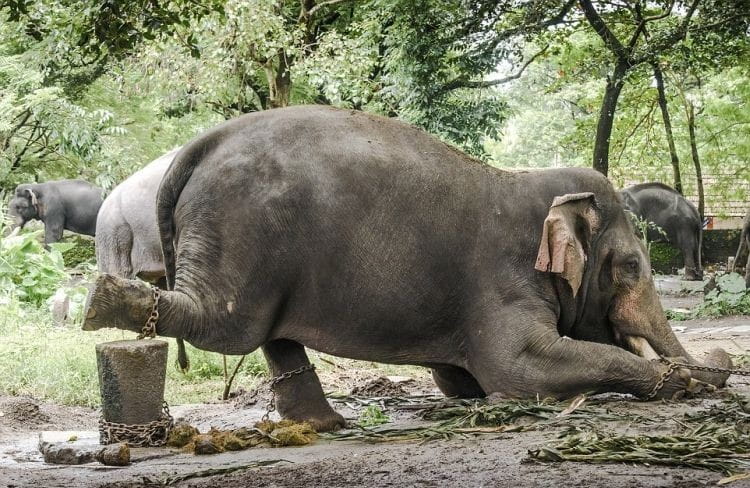
A captive elephant chained and unable to stand in India. Image supplied by Duncan McNair, on behalf of Save the Asian Elephants. Copyright: Dev Gogol/Demotix.
Building momentum
I began from ground zero, with few contacts. But many highly distinguished individuals from law, conservation, academia, politics, celebrity and campaigning responded to our calls for support. We built a team of engaged volunteers.
In 2018, I was asked by government to produce draft law. Initially, it was limited to the protection of captive elephants, but in negotiations the scope widened to all vertebrate species.
It took until 2022 to gain real traction. Raising awareness among the public had a big impact. Through advocacy, media and polling, we reached 1.2 million petition signatures. With supportive petitions we gained a further 38 million signatures.
The draft began its parliamentary journey. The government at the time and opposition parties showed stirrings of interest. Remarkably, the bill ultimately passed through the House of Commons and the House of Lords without division or amendment.
King Charles granted royal assent within hours of the final House of Lords reading on 18 September 2023. And so the Animals (Low-Welfare Activities Abroad) Act 2023 became law.
The act makes it an offence to advertise or sell tickets in England, Wales and Northern Ireland for low-welfare activities involving any vertebrate species abroad. The test is whether the activity would be unlawful were it happening here.
When implemented, these measures will throw a lifeline to numerous vulnerable species. They will also better protect the tens of thousands of humans in contact with captive wildlife. STAE’s research shows nearly a thousand people have been violently killed by captive Asian elephants alone.
In stifling UK promotion of unethical animal-related tourism abroad, domestic law can strongly influence consumer behaviour overseas. The essentials of this new law can be adopted in any jurisdiction with an unethical animal tourism market. My speeches about this at the European Parliament and elsewhere have been strongly supported.
I now lead the Low-Welfare Act Coalition – a group of 150 charities encouraging the government to progress its pre-election commitment to implement and enforce the act. STAE and the coalition have met ministers to set out which activities should be prohibited and to provide detailed evidence of the cruelty involved. Our advocacy continues – and, for now, so does the harm caused by reckless tourism practices.
A moment of recognition
My firm nominated me for the Law Society’s Legal Heroes award to acknowledge my pro bono work. Colleagues had seen me in the media campaigning and were aware of my research trips to India and Thailand. I was surprised when I discovered they had put me forward.

Duncan with his Legal Heroes Award at the 2024 ceremony. Credit: the Law Society.
I was immensely gratified to be named a Legal Hero in 2024 and very appreciative. As the Law Society approached its 200th anniversary the recognition felt especially meaningful, being the first occasion – as far as I'm aware – on which an animal cause has been acknowledged by an award. It was inspiring to meet lawyers from varied backgrounds whose work I respect. Lawyers in combination can be a prodigious force within their profession and beyond.
The acknowledgement created an opportunity to bring this topic to a large and important audience. I was moved by the number of former colleagues who contacted me about it, some from whom I hadn’t heard in decades. The daily commitment of time over a dozen years has been prodigious, and of course is nowhere near finished. But it’s exactly what I’ve wanted to do.
Collectively, the legal profession is enormously powerful. Lawyers have skills widely applicable to all sorts of causes. If 1% of solicitors gave 1% of their time for a single year, I believe we could get the Animals (Low-Welfare Activities Abroad) Act fully operative.
My advice to any solicitor looking to apply their skills to a cause they care about is let your heart be your driver. Start with a picture of what you want to do and work out if it is viable. If you have a real yearning, then you should go for it. If you have interests beyond the law, seek out a firm that supports them and allows time for them to be cultivated.
The power of law properly applied can achieve remarkable things. The legal profession can be fundamental in promoting the protection of humans, animals and the natural world. It is, after all, an independent legal system that is the ultimate guarantor of our rights and freedoms.
Lead image: Duncan with a rehabilitated elephant at a sanctuary in Thailand. Credit: Save the Asian Elephants. Duncan with his Legal Heroes Award at 113 Chancery Lane. Credit: the Law Society.
Nominate a Legal Hero
Do you know a solicitor who has driven positive change in the public interest and made a difference to an individual, group or whole community? They could be recognised as one of our Legal Heroes.