“Art allows us to hear a human voice where there might otherwise be silence”
In 2020, Maksim Znak was arrested and jailed for 10 years, simply for doing his job. Ever since, his sister Iryna has been advocating for justice. Following the opening of our exhibition ‘On the frontline for justice’, she speaks about the persecution of lawyers in Belarus, becoming a voice for her brother through her art and how small actions can affect change.
The reality for lawyers in Belarus
When I describe the situation of lawyers and legal professionals in Belarus, I usually start with a personal example from my own life.
My brother, Maksim Znak, was a lawyer. He was carrying out his professional duties and was arrested for that. He was later sentenced to 10 years in prison.
After his arrest, Maksim had six different lawyers. Every single one of them was eventually stripped of their licence and their right to practise law.
The last lawyer who represented him was my husband. He was also arrested – for a short period, 15 days – and was subsequently disbarred and banned from legal practice.
After my husband’s arrest and release, we made the decision to leave the country.
This personal story is not an exception. Since the 2020 presidential election, the persecution of lawyers in Belarus has been systematic and deliberate.
Lawyers who represent political prisoners or speak publicly about human rights violations are targeted through arrests, disbarment, administrative pressure and criminal prosecution.
That is why I often say that being a lawyer in Belarus is a risky business. Unfortunately, this phrase fully reflects the reality.
As of today, at least 17 legal professionals are imprisoned in Belarus, including seven lawyers.
Maksim’s arrest
In 2020, Maksim joined the campaign team of one of the presidential candidates, Viktar Babaryka.
After Babaryka was not allowed to register for the election, several opposition teams united. Maksim then continued his work as a lawyer for Sviatlana Tsikhanouskaya.
During this period, Maksim was doing his professional work as a lawyer. He provided legal advice, represented interests and publicly explained legal issues.
He also recorded videos in which he informed citizens about their rights and the legal framework surrounding the elections.
His activities were entirely lawful and professional. However, in the political climate of Belarus in 2020, even providing legal assistance and explaining the law to the public became grounds for repression.
Of course, this has been a profound blow to our family. When someone so close to you is taken away, you lose a part of yourself.
The first year was easier to endure because we were still able to communicate through letters. We wrote to each other actively. I sent Maksim a lot of information, and he sent me his poems and short stories.
Even though we could not see each other and were physically far apart, we were still connected.
Everything changed in February 2023, when Maksim was placed in total incommunicado detention. This situation was recognised by the UN Working Group on Enforced or Involuntary Disappearances as amounting to torture.
At that moment, it felt as if a part of my life had been torn away. It is torture for both sides, because family members have no information about a person’s health and do not even know whether they are alive.
Maksim was held in incommunicado detention for 1,039 days, until the day of his release.
Resistance through art and literature
PEN Belarus is an independent cultural and human rights organisation that defends freedom of expression and supports people working with words and culture.
For me, it’s important because it stands exactly at the intersection of literature and human rights: it protects writers and cultural figures when words become dangerous, documents repression and brings these stories to the international level.
What I value most is that PEN Belarus is not abstract.
It’s a real community that includes writers, translators, researchers, and cultural figures who share responsibility for language and memory.
Even after being liquidated in Belarus and forced into exile, the organisation never stopped its work. We have a wonderful team of experts.
In a country where books are banned and authors are imprisoned, PEN Belarus helps ensure that voices are not erased and that culture remains a space of resistance, solidarity, and meaning.
The postcards
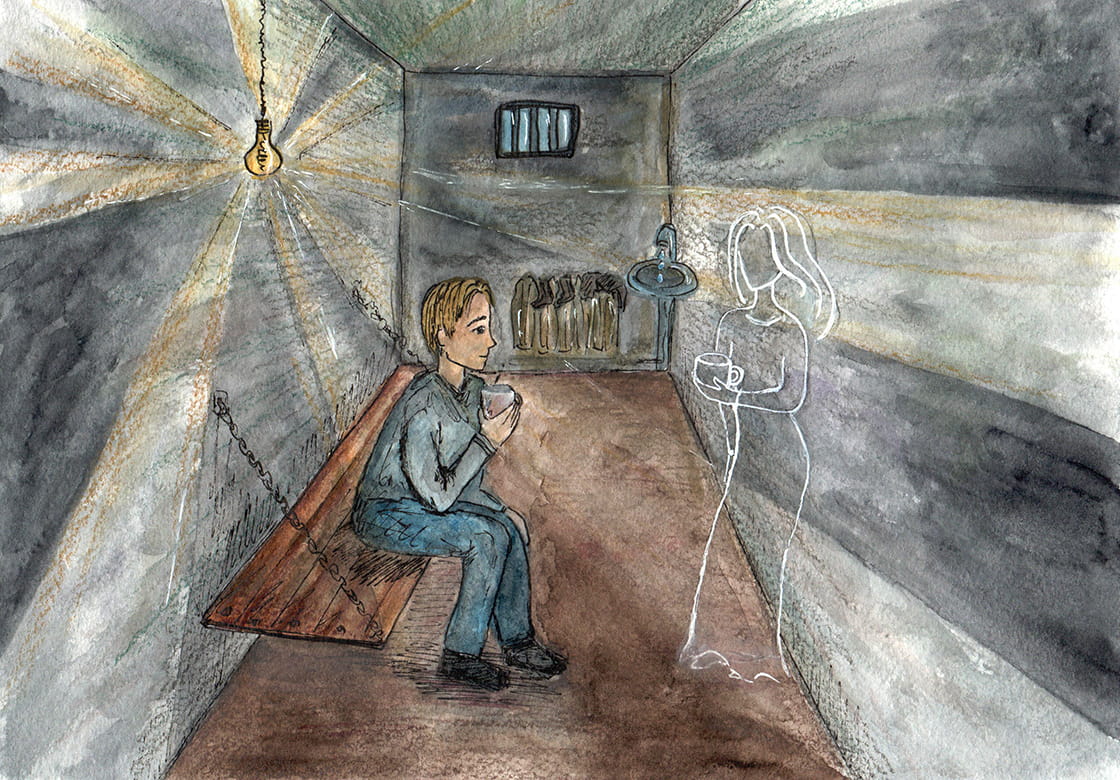
The short story behind these postcards is that I drew many of them for Maksim while he was in prison.
I began illustrating his songs – he has three music albums (listen to Max Bai on soundcloud) I drew and scanned the cards, leaving the back side blank so he could write something and send them to other people.
As a result, my postcards started circulating among many people who were writing to him a kind of visual correspondence loop.
I never thought of myself as becoming a “voice”. When you love someone, you simply cannot stay silent.
I am the younger sister – there is a 10-year age gap between us – and Maksim has always been a point of reference for me. I just tried to do whatever I could to support him.
It so happened that I was forced to emigrate, and in those circumstances – when you can no longer return home – I became the one who could speak freely. Who else, if not me, could take on that role?
In his book the Zekameron, Maksim wrote a dedication to every member of our family.
About me, he wrote: “To my sister, who has become my voice, brighter, more talented, and more sincere than my own”.
I often quote this line and say that, of course, after that I simply can’t afford not to live up to those expectations.
You can see a pair of postcards: on one, I am shown drinking tea with the “ghost” of Maksim, and on the other, he is drinking tea with the “ghost” of me.
With these images, I wanted to show that despite the distance, we think of each other and remain close in our thoughts.
The other postcards are illustrations inspired by songs, and I hope you will have a chance to listen to them.
I wasn’t thinking about politics at all when I was creating the postcards for my brother.
It came from a very simple, human place – the need to support someone you love, to stay close when circumstances try to pull you apart. It was an intimate gesture rather than a political statement.
What I do believe, though, is that when art grows out of something deeply personal and sincere, it can later take on a wider meaning.
Without intention, it can begin to speak about politics, injustice or resistance – simply because real life has made those things inseparable.
The importance of speaking up
I believe it’s important not to remain silent. It’s important to speak – not only about your own loved ones, but about everyone who has been unjustly imprisoned.
At PEN Belarus, we advocate using all the creative tools available to us.
We continue the tradition of the empty chair, placing a portrait of an imprisoned writer on it; we tell stories, read poetry and show images that carry meaning beyond words.
When I speak about Maksim, it is always deeply personal for me, and silence has never been an option.
But there are so many others who remain behind bars unjustly, often without their names being heard.
The simplest and, at the same time, the most powerful thing we can do is to tell their stories – to give them a voice.
When people encounter art, it gives them space to pause and reflect. It is a powerful combination of visual impact and storytelling – an invitation to see and hear something of their own.
Art allows us to move beyond dry statistics, to understand more deeply, to get under the skin of an experience, and to hear a human voice where there might otherwise be silence.
Fortunately, my brother was released on 13 December 2025.
This makes the story especially meaningful, because you – as visitors to the exhibition – can see the creative work and what we often call, with a beautiful word, “advocacy”, and understand that at some point it truly worked. It led to a moment when an unjustly imprisoned person regained their freedom.
I was able to see and hug my brother. He is now in exile. Ahead of him is a long journey – recovery, legalisation and finding his place in a new life. But the most important thing has already happened: a human life has been saved.
I will never tire of repeating this: we must speak. We must speak as much as possible.
And in order to be heard, we ask the international community to echo our voices – to echo our words, our hopes and our stories.
There are no small steps. Every single step becomes part of a chain of events that eventually leads to real change.
I want to know more
All over the world, lawyers are attacked just for doing their job.
Lawyers’ reputations are being tarnished, their families threatened, their futures uncertain. Yet they continue to do their work – committed to their clients, justice and a belief in the legal system.
Iryna’s postcards are on display as part of the Law Society's exhibition, ‘On the front lines for justice’, from 20 January to 20 March 2026.
Explore our exhibition and discover the stories of lawyers who are fighting on the front lines for justice.
Explore our freedom of expression report.
Find out more about what we’re doing to support lawyers at risk.