Making hybrid work in the legal sector

1. Get the most out of office days
What’s the value of coming into the office?
“If you come in and sit in a cubicle or a telephone kiosk for four or five hours doing calls, what’s the point of that? You might as well do that at home,” says Anthony Kenny, assistant general counsel corporate and CBS, GSK.
“But if you’re going to come in and I’m going to commit to you as a manager – to assist you with a project, coach you, think about your development and how we can evolve that – then I hope you will see that as worth the effort of coming in.
“And probably as something you will get more from through in-person interaction, than if we were trying to do it over video call.”
When it comes to leadership, you’ll also need to consider the purpose and benefits of office days in terms of team hierarchies and supervision responsibilities – as this can significantly impact the morale of more junior employees.
“The team dynamics have changed”, says Susan Glenholme, managing partner at Debenhams Ottaway.
“Juniors sometimes resent it if older partners or the senior staff are not in the office, but they have to be in the office. It’s about trying to balance that side of things to make sure that you are effectively supervising the person.”
2. Take a flexible approach
A hybrid approach is meant to allow employees to work more effectively – increasing autonomy and responsibility, which can in turn boost engagement, motivation and self-esteem in staff.
That means it’s important to avoid ‘blanket rules’ – and to be prepared to adapt, says Anthony.
“With my team, I’m saying, ‘It’s going to be a trust point. You could come in and do four or five hours in the office. It doesn’t necessarily mean you need to come in and sit at a desk from nine to five. Hybrid models should be about flexibility in how we work.”
This flexibility should also extend your own approach – tailoring the medium to the message you need to communicate to a team member.
“If you’re doing an appraisal, for example, we find that goes down better if you’re face to face because you might need to give a difficult message,” says Susan. “You can’t always do that remotely. And it depends on the person as well.”
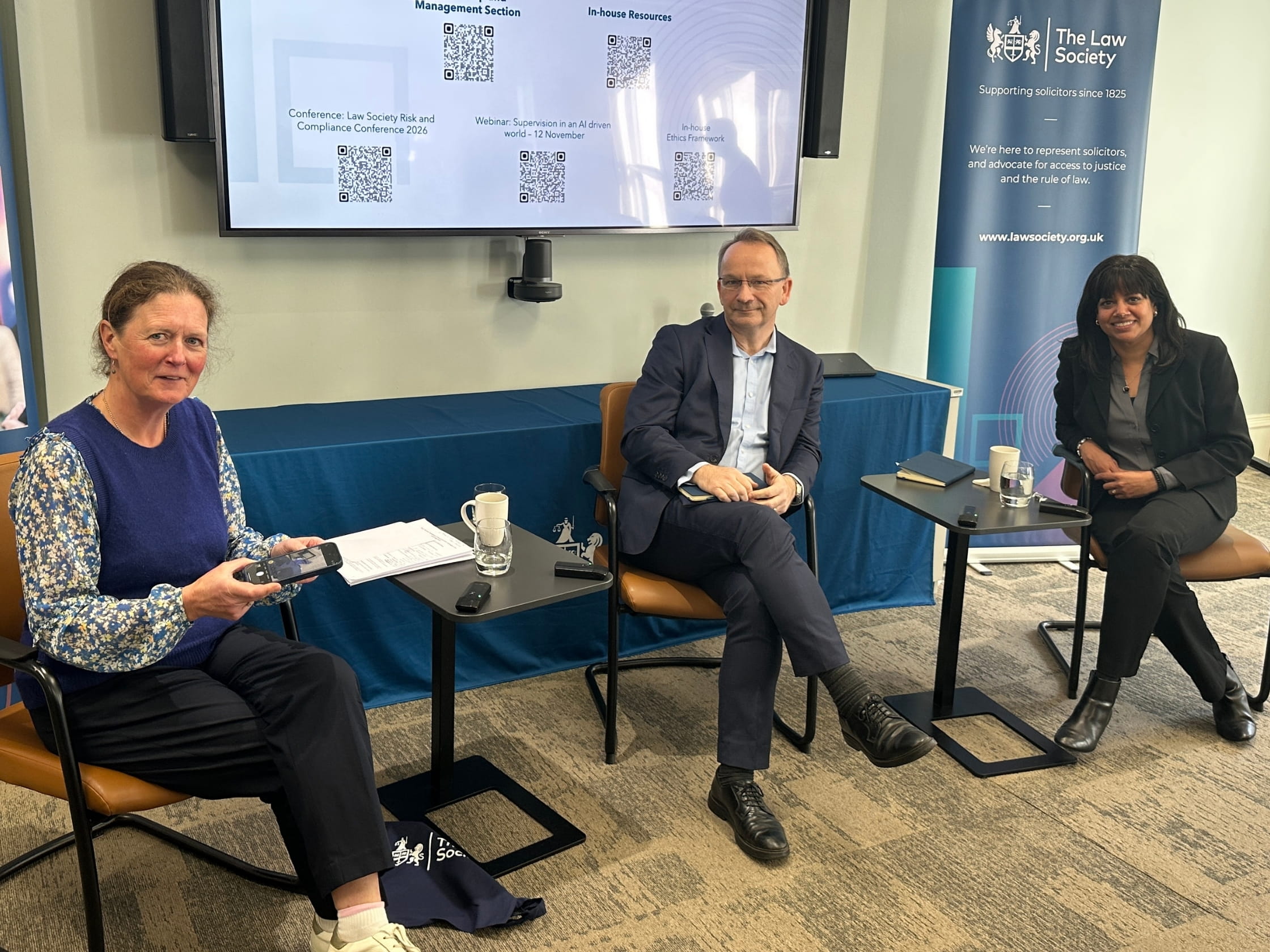
Our experts, Sophie, Anthony and Susan, at a Law Society panel event on hybrid working.
3. Make sure you have the right systems in place
In today’s workplace, individuals and different teams may be in and out of the office on different days.
Make sure your organisation centralises information about everyone’s working calendar – and that it can be found quickly.
There are ways through Microsoft Teams and other forms of artificial intelligence (AI) that can be used to capture the whereabouts of team members, which can then be tracked through calendars and HR systems.
Susan says this “allows teams to plan more effectively and communicate with clients”.
“It avoids scenarios where clients call, reception don’t know where anyone is, and they’re trying to put them through on the phone. Instead, they can look at a schedule where it’s all documented.”
4. Prioritise clarity and culture
Managers who have been working in the sector for many years might notice that trainees or juniors work differently to how they themselves remember working in at the same career stage.
“When I was trained, you were very much left to your own devices,” says Susan. “Things have changed over the years.”
Susan recommends acknowledging that the legal and careers landscape has changed – and shaping your management approach accordingly.
“It’s about trying to think differently now and considering the junior’s point of view. We now have a lot more regulation and contractual obligations.
“As a result, we’re trying to make sure we’re having regular, meaningful, documented communications and making sure that we can supervise effectively.
“When I trained, my supervising partner said, if you didn’t do something correctly, it was because he hadn’t taught you well enough. As a junior, that really made you want to help him and do the right thing.”
As technology evolves, clarity should also extend to policies around AI tools – including which tools can be used, and in which contexts.
With AI, Anthony says, it comes back to “trust”, encouraging open and honest conversations about how it’s used.
“As long as my team comply with the policy, and as long as they’re telling me where they’ve used it, rather than presenting it as their own work,” says Anthony.
“Then as a supervisor I can say, ‘Okay, if it’s been through Microsoft Copilot, I need to give it a little bit more attention than I would have done otherwise’.”
5. Support junior team members
Sophie Gould regularly speaks to employees at the start of their legal journeys. She finds many of them report similar challenges.
“They are all desperate to learn skills, but they really struggle. They say, ‘we come in and senior people may not be there, so we can't learn from them’. Or ‘when we’re working remotely, the seniors don’t necessarily think to invite us to calls’.”
She lists key development areas that juniors have reported to her:
- understanding tasks
- managing expectations
- confidence in asking for help
- presenting clearly and concisely
- stakeholder networking
- incorporating constructive feedback into future work
- how to ask for feedback
- having difficult conversations with stakeholders
- using AI
Many of the challenges around these focus areas can be compounded by hybrid working, Susan adds.
For instance, it’s more difficult to ask for support remotely than asking for a quick chat in the office while a manager is making a cup of tea.
Similarly, it can be difficult to judge performance and audience engagement after a remote presentation – and hybrid working may mean juniors have fewer opportunities to take on presentations in the first place.
To tackle this, make a proactive effort to invite juniors to calls and test out training techniques like shadow or parallel drafting.
This can be helpful in cases where a task could be a great learning opportunity – but you don’t have time to take a trainee through it because it needs to be delivered quickly.
Instead, “ask the trainee to do it at the same time as you – you deliver it on time, and the trainee has a bit longer to complete the task,” says Sophie.
“And then you both sit down and say, ‘this is what I did. Let's compare it with what you did and talk through those issues.’”

6. Build in time for networking
While working remotely, it becomes easier to neglect the value of human relationships – both with client and teams, or “the social aspects of being a lawyer” says Anthony.
This is important in terms of team morale and bonds – but also in maintaining positive relationships with clients.
“It's the chit-chat going up to the office, it’s taking people out for a drink or taking them out for lunch.”
In a hybrid working world, he says, the question is “how do we create those bonds?”.
“You can have online team events – we made it work during COVID, let's not forget that. But I think it was 60% or 70% of what you would get in an office environment. Sadly, if you’re hybrid, you’re going to miss out on that. I guess you need to consciously plan those things more.”
Making that conscious effort is key, he says. This might look like rotating meeting agendas to allow contributions from different colleagues.
Susan, meanwhile, suggests ‘anchor days’ – in which everyone comes into the office. Sophie also mentioned ‘star sign calls’ that have been organised at some firms – in which colleagues with the same star sign all attend a call together to connect.
Hybrid office networking “has to be purposeful”, Susan says, “but that doesn’t mean we can’t do it and that it can’t work well”.
7. Don’t forget about your clients
An effective hybrid setup isn’t just about staff. Through all of this, make sure you consider the impact that your ways of working can have on clients.
Susan says, “I think some clients are perfectly happy to have remote meetings, but we have a lot of elderly clients who do sometimes want to come in.
“It’s good to be able to adapt to what the client needs – and sometimes you can forget about the client when you talk about the hybrid model.
“Client experience is something we always try and focus on.”
Final thoughts?
The overall consensus from our experts is that the key to a successful hybrid working set up is intentionality – whether that’s through making the most of in-office days, factoring in time for skills development or adapting to client needs.
“You need to plan what you’re doing. Don’t just assume it’s going to happen by itself,” says Susan.
“You have to document it. You have to agree on it. If you really think about it, and think about who you’re looking after, rather than just implementing a blanket policy, it will work out.”